About
Born April 19, 1912 · Male
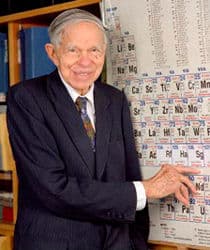
Glenn T. Seaborg was one of the most remarkable and influential chemists of the 20th Century. Born on April 19, 1912 in Michigan, he came to Los Angeles at the age of ten. After completing undergraduate studies in Chemistry at UCLA in 1934, he began graduate work in nuclear chemistry at Berkeley and received a Ph.D. in 1937. Glenn joined the faculty at Berkeley as instructor in 1939. Glenn's lifelong research effort was directed toward the radiochemical synthesis and characterization of elements. Glenn and his coworkers discovered ten transuranium elements and many isotopes that have applications in research, medicine, and industry. In 1951, Glenn was awarded the Nobel Prize in Chemistry. After serving as Director of the Lawrence Berkeley Laboratory from 1946-58, he accepted the position of Chancellor at UC Berkeley. In 1961, Glenn was named Chairman of the U.S. Atomic Energy Commission, a position he held for ten years. Glenn played a key role in the conclusion of the treaty that banned the testing of nuclear weapons in the atmosphere. Glenn was the recipient of many awards, including the National Medal of Science and the Enrico Fermi Award, and held the unique distinction of having element 106, Seaborgium, named after him. Glenn remained active in research, education, and public service until his death in February, 1999.
Experience

TAE Technologies
View →Founder
Acquired287Foothill Ranch, California, United StatesClimate · Electrical/Electronic Manufacturing
Education
- University of California Berkeley · Ph.D., Chemistry– 1937
People at TAE Technologies

Data from: crunchbase